
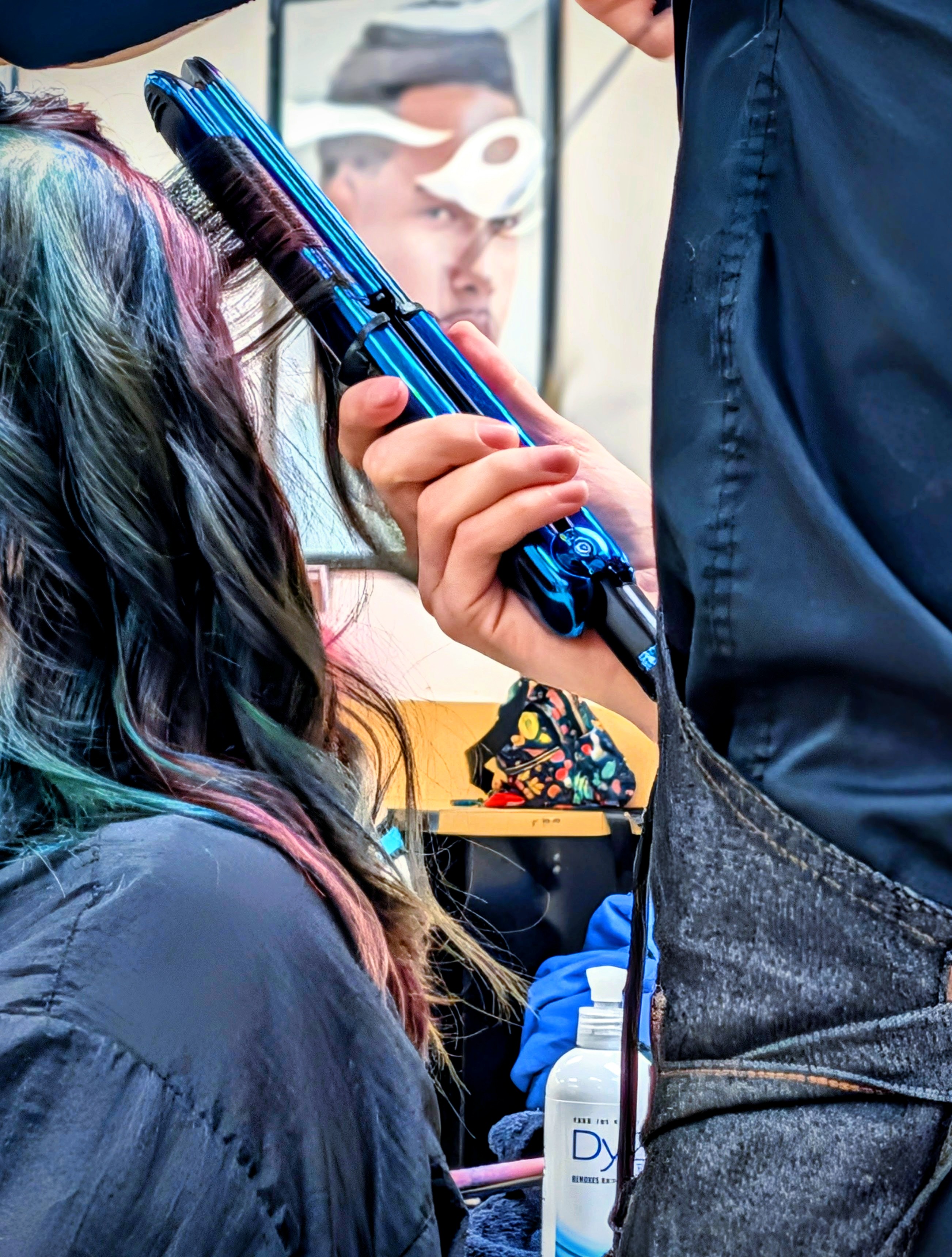
A short guide to surviving your first years as a professional stylist.
Welcome to the salon floor. You have your license, your freshly sharpened shears, and enough anxiety to cripple a Clydesdale.
Social media paints the beauty industry as a highlight reel of blended balayages and luxury independent suites. What it skips over is the raw reality of the daily grind. Earning your place behind the chair requires sweat, sore wrists, and unapologetic consistency.
If you’re lucky, you’ll have landed in a salon with at least one great mentor who will take the time to teach you everything they couldn’t get to in beauty school. If you’re like over half of new professionals, you’ll end up quitting before it’s even time to renew your license because, as it turns out: “Not everything that glitters is gold.”
But don’t despair young professionals! (Side note: Can we stop calling everyone who has just entered the industry “baby stylists?” It’s infantilizing. It’s weird. We’re all professionals whether we’ve had our license for 20 days or 20 years.) I’ve come to save the day and hopefully make those turbulent first few years a little less miserable. Because at the end of the day, I believe a rising tide lifts all ships; i.e. When the industry continues to grow, we all benefit.
Part I: Mastering the Craft

Don’t learn haircuts. Learn how to cut hair.
Memorizing a step-by-step haircut from a YouTube video will only get you so far. Seeing as you aren’t the stylist that made the tutorial, and your client likely isn’t the model from the video, chances are when you try it in the salon, the end result won’t be the same. Understand the why, not just the how. Elevation, over-direction, tension, finger angle, and head shape all work together to form the final product. A shift in any one of these can drastically change how the hair lies. That’s not to say there isn’t any value in watching a haircut tutorial, you just have to know where to look for it. Once you understand the geometry and mechanics of cutting, you can build any shape on any head that walks through your door.
The more you f*ck around, the more you find out.
When I was in beauty school, I won several hair color competitions. This was always my answer to the question, “How did you get so good at hair color?” Get your hands on as many heads as possible. And don’t be paralyzed by the fear of making a mistake. Mistakes are merely aggressive learning opportunities. When it comes to hair color especially, almost everything you do can be fixed. Test the limits of your lightener on mannequins. Try out weird formulations on your friends. Learn exactly what happens when you push boundaries, and then how to correct it when things go south. My mentor once said, “I don’t make mistakes; I just learn which path not to take to my destination next time.” Because in this industry, perhaps more than any other, the ends will always justify the means.
Respect the chemistry.
The color wheel is your absolute gospel. Never blindly trust the swatch book; always account for the canvas you are working on. In fact, I rarely show my clients the swatch book. I can’t remember the last time I used a formula with a single color. Having access to pro-grade color and chemical lines is a responsibility, not just a perk. Learn the chemistry behind the products in your backbar. Almost every professional line, to varying degrees, has free education available online. Most of it is behind a license wall (you have to verify your license/student status before gaining access). Take advantage of it. Even if you don’t use that line. Educating your clients on why professional products perform better than drugstore alternatives is exactly how you build trust (and retail sales if that’s something you care about).
Build technical mastery.
Everyone wants to immediately jump into viral techniques and fast appointment times. But trust me, if you can’t properly execute the basics, like a meticulously sectioned platinum card or a perfectly clean perimeter line, everything is going to look sloppy and your client will cry in their car for 30 minutes after their appointment. Speed comes with repetition. Focus entirely on clean sections, even saturation, and protecting the integrity of the hair. Rushing will only force you to spend twice as long fixing it later. Besides, when I was starting out working at a chain salon known for quick haircuts, the most repeated praise I received was, “That was the most thorough job anyone has ever done here.” I wasn’t trying to stay within company standards for haircut times; I was trying to give people a great haircut.
Part II: The Business of People

The consultation is 90% of the service.
When I tell my clients I spent over a decade as an Executive Chef before I started doing hair, they always ask how the skills transfer from one industry to another. The technical skills may not be comparable beyond using tools that are insanely sharp or blazing hot, but when it comes to the soft skills, they’re almost 1:1. If you and the client aren’t on the exact same page before you pick up your shears, the best technical skill in the world won’t save you. Repeat their requests back to them, look at picture references, and always clarify what they don’t want. Sometimes you need to understand what someone wants even when they don’t share the same technical vocabulary as you. Even though a taper and a fade can look exactly the same, the difference being solely in the technique (a hill I’m willing to die on), your average client likely only knows the terms based on what social media taught them. Inspiration pictures help if you know how to use them. Even when a client sits down with five layers of box black dye and shows you a photo of Daenerys Targaryen, be brutally honest about the journey. Under-promise, set realistic expectations, and then over-deliver.
Not all money is good money.
It is incredibly tempting, especially when you are trying to build your book, to say yes to every single person. But taking on a client who disrespects your boundaries, haggles over prices, or demands a chemical service that will melt their hair off is never worth the paycheck. Learn to identify red flags. Firing a toxic client frees up a time slot for someone who actually values your art. Doing 30 haircuts every day or working 50-60 hours a week is only putting you in the fast lane to Burnout City. Protect your peace and your physical body.
Stop counting your client’s pockets.
Charge what your time, skills, and products actually cost. Do not offer unprompted discounts just because you assume a client can’t afford a service. And don’t develop the habit of emotional discounting. Know your worth, communicate your prices clearly, and stand by them without apologizing. It’s tempting to offer coupons when you’re building a book just to get butts in your chair, but be aware that coupons don’t attract loyal clients. They attract couponers who won’t be back until the next time you offer a discount. There are plenty of establishments that offer lower-priced services. While there is nothing inherently wrong with those places, it’s worth considering if you plan on building your brand as a mid- to high-end stylist. It’s also worth looking into what other salons in your area are charging for the same services. Trying to undercut the competition by offering the cheapest haircut will attract clients who are looking for exactly that.
Retention beats viral acquisition.
Take the extra five minutes for photos, because in this industry, your social media portfolio is your resume. But remember that having a viral reel that brings in twenty new clients means nothing if none of them rebook. Focus on the experience. Remember their kids’ names, remember how they take their coffee. Pretty much every salon software or client management system has a space to keep notes. If not, make a Google Sheet or just a simple note in your phone to keep track of it yourself. Give every single client a consistent, high-quality result every single time.
Part III: Playing the Long Game

Redefine your professionalism.
The days of needing to act like a corporate robot to be respected are over. True professionalism is about showing up on time, maintaining a sanitary workspace, and delivering a great service, which includes regularly maintaining your tools and your station. Get your shears sharpened, lube your trimmers, sanitize your tools, and sweep up the hair. Beyond that, be yourself. You attract the type of clients you market yourself to (consciously and subconsciously). If you dress like a business professional, you’ll attract business professionals. If you wear studded belts and ripped skinny jeans, you’ll attract the alternative crowd. If you don’t put any effort or intention into your appearance, you’ll attract clients who also don’t put effort or intention into their appearance. One of the first things you learn about professionalism in school is to not talk about politics or religion. But if those topics are something you’re passionate about, talk about them as much as you want. Sure, you run the risk of alienating some potential clients, but remember: “Not all money is good money.” If you curate an authentic vibe, you’ll build a clientele that meshes with your personality, and going to work won’t feel like putting on a mask.
Drop the scarcity mindset.
There are more than enough heads of hair in your town to keep everyone’s books full. Tearing down the stylist at the station next to you just makes the salon environment toxic. Trashing the salon down the street sets the expectation for your client to do the same to you should you ever make a mistake on them. Stop gatekeeping and start collaborating. Share your formulas, hype up your coworkers’ work, and be willing to refer a client to someone else if it fits their specialty better. I have a regular client who comes to me to get her hair cut and blow-dried, then heads across town to a salon that I recommended to get her hair braided. I’ve also gained clients wanting vivid color from a friend who specializes in bridal hair and makeup. When we view each other as peers instead of competition, clients get better results and we gain their trust, which in turn leads to more loyalty.
The education cycle never stops.
The beauty industry evolves ridiculously fast. The moment you get comfortable is the moment your career is over. Right now, you are the sponge, absorbing every trick you can get your hands on. Take it seriously now, because eventually, the cycle continues. One day you’ll be the veteran heading back to your local beauty school as a guest speaker to teach the night class how to do platinum cards for the next generation. Keep learning, and stay hungry. Don’t be the stylist who is still putting clients with bleach in their foils under the dryer or mixing up a soap cap with permanent color instead of just using a demi because “that’s how we did it back when I started 30 years ago.” Splotchy color looked bad then, and it’s unacceptable now.
This career isn’t just about the hair; it’s about the people you impact and the craft you relentlessly pursue. You’re going to have days where your wrists ache, your feet throb, and you wonder if you’re cut out for this. But then you’ll have that one client who leaves your chair standing a little taller, looking at their reflection with genuine joy, and you’ll remember why you started. Stay humble, keep your shears sharp, and never lose that hunger to improve. Remember: we’re all in this together, and a rising tide really does lift all ships. Now get back out there and make some magic happen.
Leave a Reply